Determining the exact number of leaves on a cannabis specimen is a common inquiry for cultivators seeking to optimize photosynthetic efficiency. However, if you are asking how many leaves does a female cannabis plant have, you must understand that the answer is highly variable and contingent upon the plant’s genetics, age, and environmental conditions. A mature female cannabis plant can possess anywhere from several dozen to several hundred, or even thousands of leaves, depending on whether it is a small indoor autoflower or a large outdoor photoperiod giant. This variation is primarily driven by the plant’s vegetative vigor and the cultivation techniques employed by the grower, such as topping or low-stress training. Understanding the morphology of these leaves—ranging from the iconic fan leaves to the resin-coated sugar leaves—is essential for monitoring plant health and predicting yields. By analyzing the factors that influence leaf production, we can gain a deeper understanding of the biological architecture of the female cannabis plant and its developmental milestones throughout its lifecycle.
How Many Leaves Does a Female Cannabis Plant Have?
Determining the Total Leaf Count on a Female Cannabis Plant
The total number of leaves on a female cannabis plant is never a fixed integer. Instead, it is a dynamic figure that changes daily as the plant progresses through its life cycle. During the initial seedling stage, a plant may only have two cotyledons followed by its first set of true leaves. As it enters the vegetative stage, the rate of leaf production accelerates exponentially.
In a controlled indoor environment, a typical plant might develop between 50 and 300 leaves before the flowering phase is induced. In contrast, outdoor plants grown in high-UV environments with unlimited root space can grow into massive shrubs. These large specimens often host thousands of leaves to maximize solar energy collection for flower production.
Botanical Differences Between Leaf Types
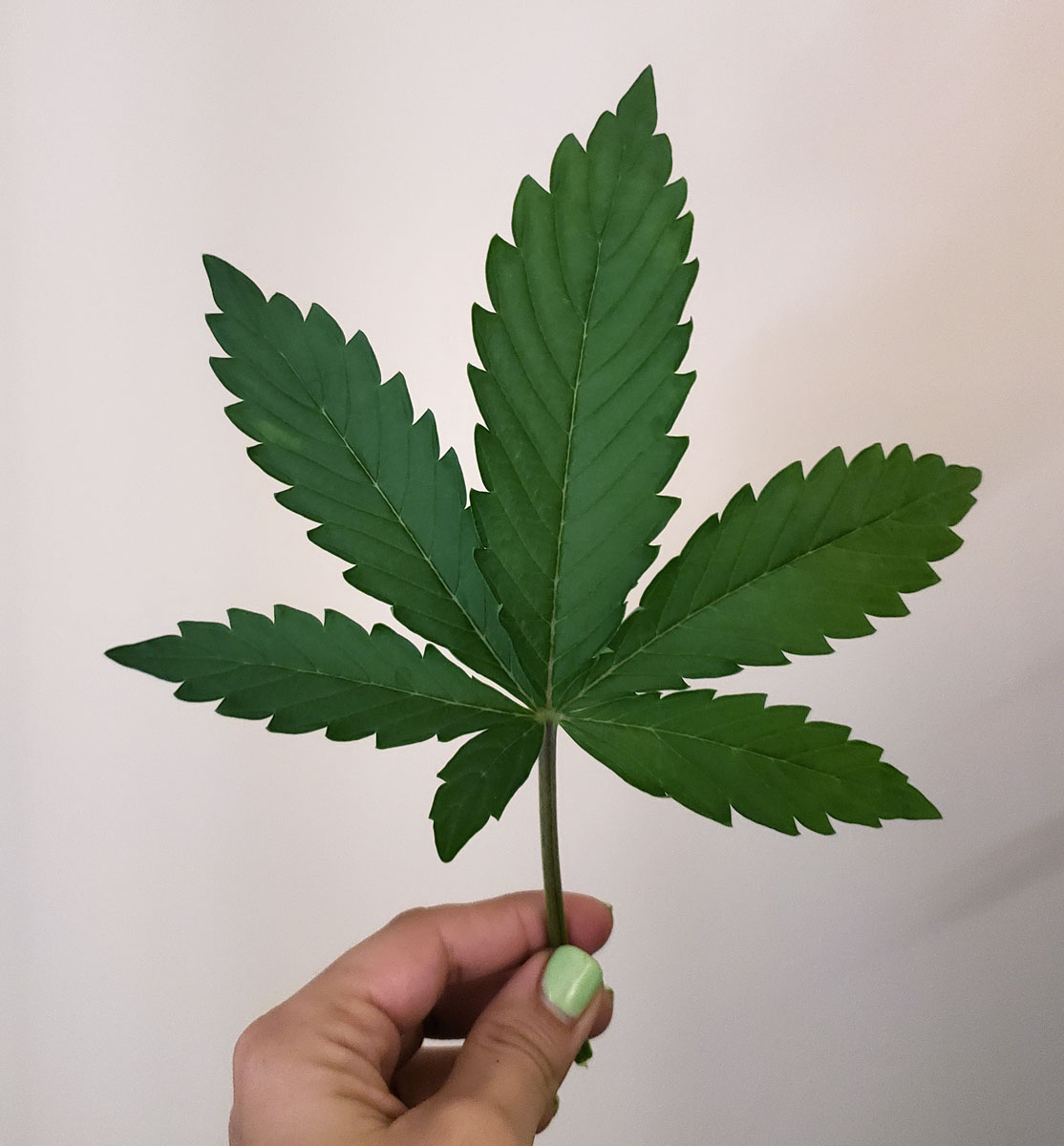
To accurately count leaves, one must distinguish between the two primary types found on a female plant: fan leaves and sugar leaves. Fan leaves are the large, iconic multi-fingered leaves that serve as the plant’s primary solar panels. They capture light and facilitate transpiration, but they are generally removed after harvest because of their low resin content.
The Role of Phyllotaxy in Leaf Arrangement
The arrangement of these leaves, known as phyllotaxy, determines how many leaves appear at each node. In the early stages, cannabis exhibits opposite phyllotaxy, where two leaves emerge from a single node. As the plant matures, it often shifts to alternate phyllotaxy, which can significantly increase the leaf count and density along the main stem and lateral branches.
Sugar leaves, conversely, are the small, single-fingered or three-fingered leaves that emerge directly from the inflorescence (the buds). These leaves are typically coated in trichomes and are much more numerous but smaller in surface area. When calculating how many leaves does a female cannabis plant have, the inclusion of sugar leaves can easily double or triple the total count during the late flowering stage.
The Impact of Pruning and Defoliation
Anthropogenic intervention plays a massive role in final leaf counts. Many growers practice defoliation—the strategic removal of leaves—to improve airflow and light penetration to lower bud sites. This practice deliberately reduces the leaf count to focus the plant’s metabolic energy on floral development rather than foliage maintenance.
- Lollipoping: Removing all lower growth and leaves to prioritize the top canopy.
- Topping: Cutting the main apical meristem to encourage the growth of multiple main branches, which increases the potential for more nodes and leaves.
- Schwazzing: A heavy defoliation technique performed during the first and third weeks of flowering.
Comparison of Leaf Characteristics and Growth Factors
| Cannabis Variety | Average Leaf Size | Leaf Density | Finger Count |
|---|---|---|---|
| Cannabis Indica | Broad and Wide | High/Dense | 7 to 9 fingers |
| Cannabis Sativa | Narrow and Long | Low/Open | 9 to 13 fingers |
| Ruderalis (Autoflower) | Small and Rugged | Moderate | 5 to 7 fingers |
The environment also dictates leaf production speed. Higher levels of CO2 and optimized nutrient profiles (specifically nitrogen) will lead to a more prolific leaf count. Below is a table detailing the external factors that influence the total number of leaves a plant will produce.
| Environmental Factor | Impact on Leaf Count | Reasoning |
|---|---|---|
| Light Intensity | Increases count | Higher photosynthetic rate drives faster nodal development. |
| Nitrogen Levels | Increases count | Nitrogen is the primary macro-nutrient for vegetative foliage. |
| Container Size | Increases count | Larger root systems support a larger aerial biomass. |
| Temperature | Variable | Extreme heat or cold can stunt growth and reduce leaf emergence. |
Key Takeaways
- Leaf count is highly variable, ranging from dozens to thousands depending on the growth environment.
- Genetics determine the shape and potential density of the foliage.
- Fan leaves manage energy production, while sugar leaves protect and support the reproductive organs (buds).
- Pruning techniques like topping will increase the total number of leaves by creating more branching sites.
- Monitoring leaf health is more important than the specific numerical count for successful harvesting.
Frequently Asked Questions
Do female plants have more leaves than male plants?
Generally, female plants are bred and cultivated to be bushier and more robust to support the weight of heavy flowers. While the genetic potential for leaf count is similar, the longer vegetative periods and training techniques applied to female plants usually result in a higher leaf count than males, which are often culled early.
Can a cannabis leaf have an even number of fingers?
While cannabis leaves typically have an odd number of fingers (5, 7, 9, or 11), it is not uncommon to see leaves with an even number due to genetic mutations or environmental stress. This does not necessarily indicate a problem with the plant’s health or its sex.
Why is my plant losing its lower leaves?
This process is often natural senescence, where the plant redirects mobile nutrients like nitrogen from older, shaded lower leaves to newer growth at the top. However, if leaf loss is rapid, it may indicate a nutrient deficiency or improper watering.
Does the number of leaves affect the potency of the buds?
Indirectly, yes. A healthy leaf canopy provides the carbohydrates necessary for resin and cannabinoid production. However, too many leaves can shade bud sites, reducing the production of THC and terpenes in those specific areas.
About the Author